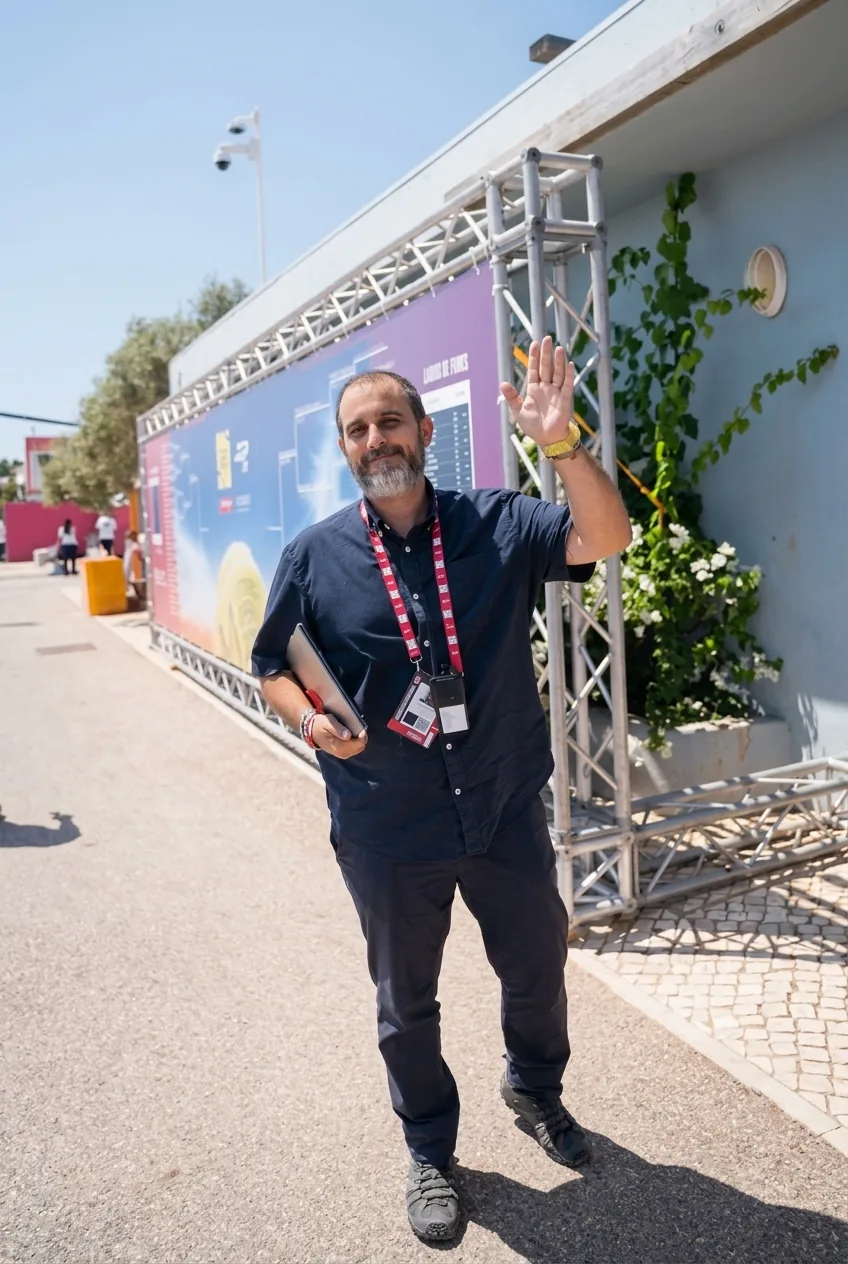
André Paiva: Head of IT and Technology Operations at the Millennium Estoril Open since 2015
What began as a three-day assignment providing user support and installing printers grew into an ongoing collaboration with one of the leading tennis tournaments held in Portugal.
Since 2015, André Paiva has been responsible for planning, coordinating and overseeing the technology operations of the Millennium Estoril Open. An experience built on the ground that launched his career in event technology and, later, led to the creation of Do IT Happen.
“If I had to sum up this relationship in one word, it would be pride.”
From a three-day assignment to an ongoing responsibility
André Paiva's connection to the Millennium Estoril Open began in 2015, the year Portugal once again hosted an ATP 250 tournament.
At the time, André was working as a freelancer for Futurdata. The initial assignment was to provide user support and install printers during the three days leading up to the event.
On the final day of the build-up, a member of the organisation invited him to stay on for the tournament and look after the IT area.
What was meant to be a one-off intervention became the start of an ongoing collaboration, sustained across every edition held since.
The scale of the event exposed him to very different needs. The organisation, the ATP, the press, players, production, sponsors and technology partners all depended on systems and connections with distinct levels of priority and criticality.
In the early years, many requests only surfaced during the event itself. Responding meant being able to weigh priorities, understand the impact of each situation and quickly coordinate the solution with the right teams.
“The Millennium Estoril Open was the turning of a page and the start of a career I'm proud of.”
The link between the organisation and the technology operation
Today, André Paiva is the Head of IT and Technology Operations at the Millennium Estoril Open.
His role is to plan, coordinate and oversee the IT infrastructure and solutions the tournament needs to run.
He is also the main point of contact between the organisation and the provider responsible for internet and communications across the venue.
The work involves understanding how each area operates, gathering requirements, assessing the feasibility of the needs presented and turning them into concrete implementations.
The technology operation serves four core areas:
- ATP;
- Press;
- Production;
- Venue.
Each area has its own requirements for connectivity, security, availability, location and support.
Beyond the organisation and the technology provider, André coordinates needs with ATP Media, broadcast teams, technical operators, security, sponsors and the entities running activations and services across the venue.
His accumulated experience means many of these partners contact him directly before and during the event.
Even when an issue falls outside his direct remit, André is often called upon to identify the right team, route the request and speed up its resolution.
An operation that starts months before the tournament
Technology preparation usually begins three to four months before the event.
At this stage, the venue floor plans are analysed alongside the organisation's needs, the requirements of the ATP and the press, and the requests from partners and sponsors.
Working from the floor plan, the locations of network cabinets, switches, Wi-Fi access points, printers and other equipment are mapped out.
The on-site operational phase starts two to three weeks before the tournament opens.
During this period, the build-up is monitored, infrastructure is installed, networks are configured and the different services are tested.
The work only ends after the equipment, networks, printers and communication systems have been dismantled — usually within two days of the tournament's close.

An infrastructure built for thousands of devices
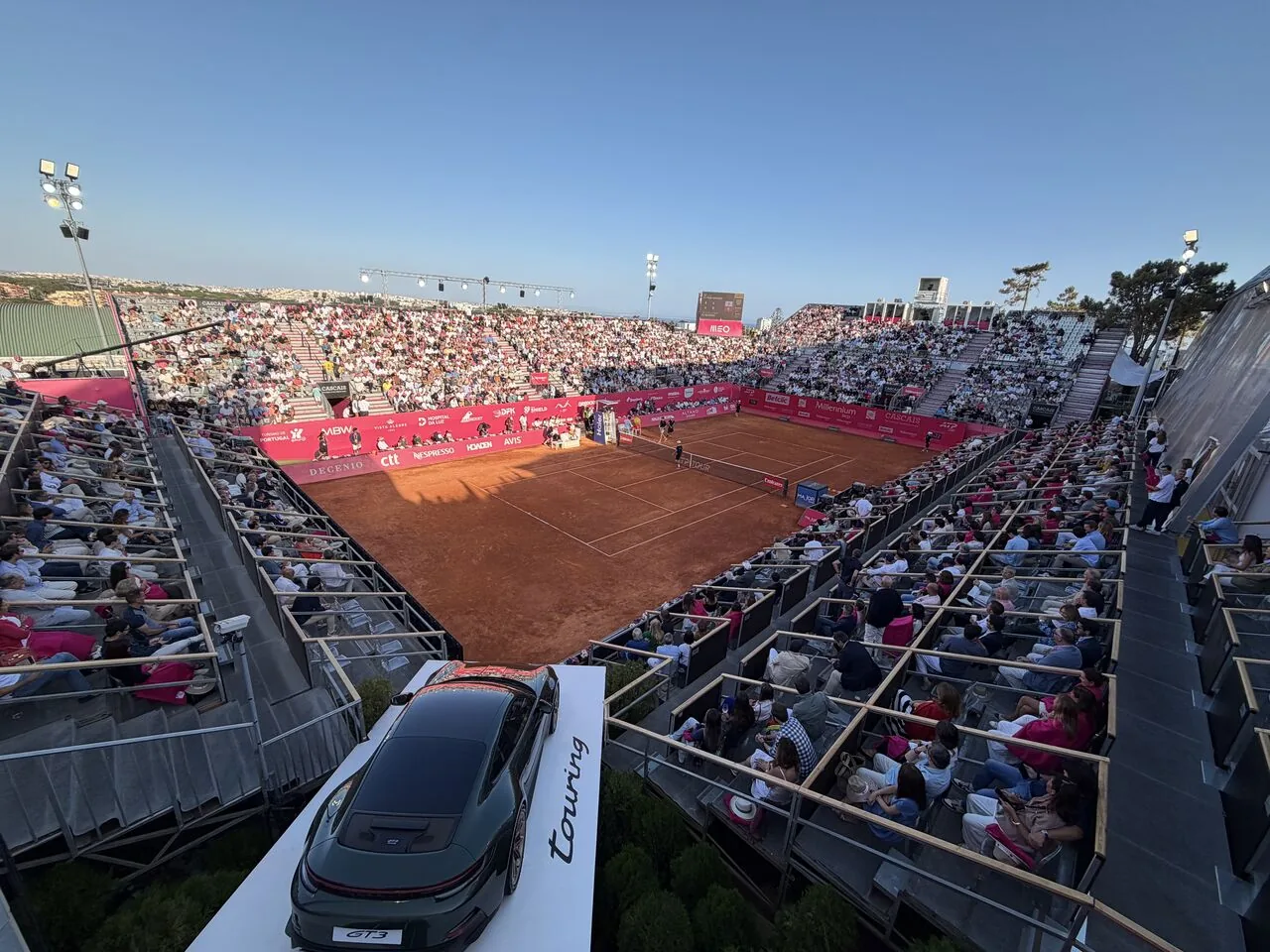
At the 2026 edition, over 4,000 different devices connected to the Millennium Estoril Open's private networks.
On the OFFICE network alone — used by the organisation and production — over 140 distinct devices were registered.
Handling this volume takes far more than simply providing internet access.
It requires understanding who uses each connection, what each device is for, what level of availability is required and what the impact of an outage could be.
A connection serving a press team, an ATP service, a security system or an on-site activation can have completely different requirements.
André's work is to organise these needs, set priorities and make sure the infrastructure has been prepared to handle each of these realities.
Preventing problems before they need solving
Prevention is one of the core principles of André Paiva's approach.
Several years ago, while preparing the technical requirements, he requested that the main network cabinets be protected by UPS systems.
That decision has reduced the impact of generator issues and temporary power failures.
The UPS units provide roughly 15 to 30 minutes of autonomy, preventing a power interruption from causing an immediate loss of communications and giving the teams time to restore supply.
The network was also designed with a ring topology and redundant paths.
If a failure occurs at a given point or along a given route, connectivity can still be maintained through another cabinet and another path across the network.
This architecture doesn't eliminate every power-related risk, but it significantly reduces the impact of a localised failure.
“I've always preferred to prevent rather than fix. At an event of this scale, a decision made months in advance can avert a critical problem during the tournament.”
Less cabling, faster build-ups and a more efficient operation
One of the biggest operational advances was using the technology provider's fibre to create point-to-point links between different zones of the venue.
Previously, several services installed their own cabling to connect equipment located in different areas.
Planned use of the existing fibre made it possible to support different operations over a shared infrastructure.
Among other examples, this solution is used for:
- CCTV systems;
- Distributing content and live matches across the public areas;
- Links used by the scoreboards;
- Communications between technical zones;
- Services required by production and event operations.
The change reduced the teams' build-up time, avoided duplicated cabling and significantly cut visual clutter across the venue.
The technical partners clearly recognised this evolution.
For many visitors and users, however, the improvement went unnoticed. That invisibility is itself a marker of success: the technology works without getting in the way of the event experience.
From a flood of requests to very few connectivity complaints
In the first edition, André received a high number of requests and complaints.
Many were related to usage, device configuration and users adapting to the scale and pace of the event.
As planning, infrastructure and coordination between the various entities evolved, complaints directly related to connectivity became very rare.
When incidents do occur, they are usually tied to localised power failures rather than the capacity or dimensioning of the network.
The stability of the connections serving the press carries particular weight.
Journalists, photographers and communications teams are responsible for carrying the tournament's image to the outside world. Technology cannot become an obstacle to their work.
The low number of complaints and the recognition of the partners are therefore two of the main indicators used to measure the success of the technology operation.
An application built during the tournament itself
At the 2026 edition, André spotted an opportunity for improvement at the Players Restaurant.
Until then, registration and access control were handled with printed sheets and manual record-keeping.
The process made information hard to consult, increased the chance of errors and slowed down the control of players, teams, guests and paying participants.
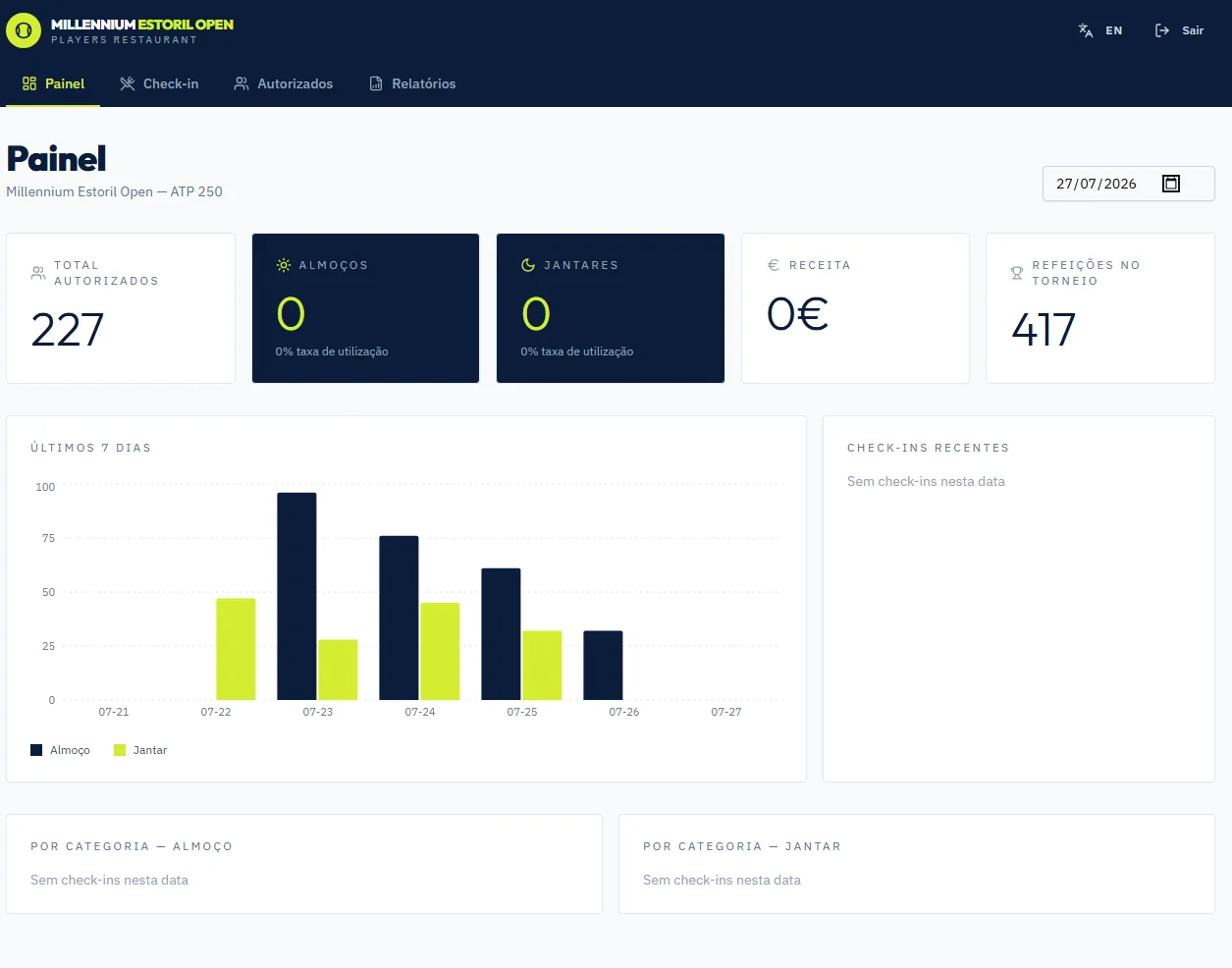
During the tournament itself, André built a digital application using AI-assisted development.
The solution made it possible to:
- Import the daily list of authorised people;
- Register players' guests;
- Search quickly by name;
- Complete check-ins;
- Add companions;
- Include paying participants;
- Track lunch and dinner separately;
- Consult data by day or by meal;
- Export daily reports;
- Produce a final report.
Because the application was developed while the event was already under way, direct badge scanning was not included in the first version. That feature is planned for a future iteration.
The solution was used to manage 417 meals over five days — five lunches and three dinners.
The implementation reduced errors, improved operational control and cut the time needed for each check-in.
The organisation's lead for the players' area thanked the team for the implementation and asked for the application to be used again in future editions.
Experience at events of global scale
The Millennium Estoril Open marked the start of a career dedicated to applying technology to events.
Over the years, André has also worked on other highly complex projects, consolidating his skills in coordination, implementation and support in critical environments.
One of the major milestones came in 2022, during the United Nations Ocean Conference held in Lisbon.
André was responsible for local IT and coordinated a team of 15 people.
The operation involved 22 days of installation, the deployment of over 400 devices, accreditation systems and on-site support for an event of global scale.
For his work, he received a Certificate of Appreciation from the United Nations in recognition of his outstanding performance supporting the 2022 Ocean Conference.
The experience strengthened his ability to lead teams and deliver technology solutions in highly demanding international contexts.
From experience in the field to the creation of Do IT Happen
For several years, André worked on projects where the initial client relationship was handled by sales teams.
Often, the real needs only became clear during the build-up or at the venue itself, forcing pre-defined solutions to be adapted on the ground.
The desire to be directly involved in identifying the problem, making the decision and implementing the solution was decisive in creating a project of his own.
In March 2026, André founded Do IT Happen.
The company began with the development of a custom digital solution and evolved into two main areas:
- EventsApp, dedicated to forms, registrations, communications, check-in, accreditation and the technology management of events;
- Do IT Translate, an AI-assisted translation platform.
Since the 2026 edition, responsibility for the Millennium Estoril Open's technology operations has been officially delivered through Do IT Happen.
The company is the product of experience accumulated in the field and the drive to build solutions focused on the real pain points of events.
A journey built on trust
What began in 2015 as three days of technical support became an ongoing responsibility across every edition of the Millennium Estoril Open held since.
Along the way, André Paiva went from support technician to the central point of technology planning and coordination for an ATP 250 tournament.
The Millennium Estoril Open gave him the opportunity to believe in his own abilities, take on ever greater responsibilities and develop his own vision of technology applied to events.
That vision was the origin of Do IT Happen.
Today, the company turns the experience gained in the field into its own solutions, direct relationships with clients and the ability to identify, prevent and solve the operational challenges of every event.
“Do IT Happen comes from that kid who once went to the Millennium Estoril Open to help set up a few printers and support accreditation for three days.”
Testimonial
“André Paiva and DO IT HAPPEN have been working with the Millennium Estoril Open for 11 years, always with professionalism, dedication and responsiveness. A trusted team, attentive to detail and able to find solutions in a demanding event like ours.”
Born from real event experience
Technology for your event, with operations on the ground
Talk to us about registrations, check-in, AI translation or the technology operations of your next event.
Request proposal